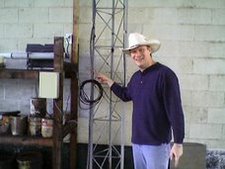
As the demand pours in all over the world, viewers from new to old countries look at our project at the worlds first open source global community project. Having resources benefiting global economic & media, Wireless Worlds CEO starts inking deals country by country to handle local business developments a whole, but as a sub of the whole. Each division is in charge of a certain section of the total development and we are proud to announce relationships developing globally to yield true mobile resources.
As the development hits over 20,000 man hours, Greens scientists are determined to bridge the digital divide and allow low cost internet at $10 a month availabale everywhere, powered by everyone. Sharing the expense of the network is the least of our problems in todays world. We are just excited to see so many thousands of people wanting mobile mesh service in their part of the world. Order your code today!
What does it cost ? Greens group asks for local government of provide funding and support in local markets they service and to work on donations of thousand of computers needed in every country across the world alike. Here in the US our local group was blessed we have the fortune 500 in the US to donate thousands of computers and recyclable hardware. The project now code name "Tunza" which means hope, needs more schools and universities wanting to teach on our universal platform. The money they spend, we give a proton immediately back in local grants to students far and local giving oppertunity its just due.
We are happy thus far but need more local development. Cheap wireless access impacts allot of people, and some say its crazy, but actually its simple. add the second wireless card, and you have your own wireless network for home friends or family, for free. This new feature will allow all mobile mesh devices manufactured in 2007 and current to be upgraded at no cost, buy purchasing the card and pigtail needed. Code already supports multiple cards. Keep 5 channels of separation between your existing RF and your new home network. See http://wirelessworlds.com for more!
if your interested in more about our project visit http://www.wirelessworlds.com
or fill out the form below. Thanks. Ted.
Powered by Wufoo
Sunday, May 4, 2008


Sunday, April 27, 2008
Clustr Maps of Global Visitors

Clustr maps now provides global tracking for visitors. With new clustering being added the group wanted to see a visual layout of where most of our global traffic came from, and how large it was.
Link to site
Friday, April 25, 2008
The "G" Spot - Americas 3G/4G hardware !

many people looked confused when we released our latest sexy wireless division called the G-spot GSM series. These system are made for GSM aka the G, and no its not 802.11b/g, it is short for GSM, which the world is scrambling right now to deploy and master!
Well here is a preview of her now....
Trinity to the Rescue?

Could our Trinity GSM phone come to the rescue including 3G and 4G international standards? The 855 has been on the Asian market for a while now and seems to have not even beginning to peak. See our newest cellular master piece called the "g" Spot.
Mesh on VMware?

Is it really possible to rework vmware to handle the needed network devices add clusterng support and support wireless projects ?
Download VMware Server (link)
Wednesday, April 23, 2008
VideoLAN Solution overview
VideoLAN is a complete software solution for video streaming, developed by students of the Ecole Centrale Paris and developers from all over the world, under the GNU General Public License (GPL). VideoLAN is designed to stream MPEG videos on high bandwidth networks.
The VideoLAN solution includes:
VLS (VideoLAN Server), which can stream MPEG-1, MPEG-2 and MPEG-4 files, DVDs, digital satellite channels, digital terrestial television channels and live videos on the network in unicast or multicast.
VLC (initially VideoLAN Client), which can be used as a server to stream MPEG-1, MPEG-2 and MPEG-4 files, DVDs and live videos on the network in unicast or multicast ; or used as a client to receive, decode and display MPEG streams under multiple operating systems
Here is an illustration of the complete VideoLAN solution:

Saturday, April 19, 2008
Subscribe to:
Posts (Atom)